

UC San Diego CSE alumnus Noah Martin (B.S. ’16) got his start in hackathons as an undergraduate majoring in computer engineering. Together with three of his fellow students in CSE, Martin shared in the prize for Best iOS Hack for ezTouch, an app to lock and unlock your computer from anywhere, at the HackSC hackathon in 2014 at the University of Southern California (where Martin is now doing an M.S. in computer science). He also did internships as a software developer at Lab126, Yelp, Apple and Airbnb, and started a small company called ThnkDev in 2012 with UC San Diego economics major Josh Cohenzadeh (B.A. ’15), who creates software with Martin. Their titles include QuickRes and Screenie.
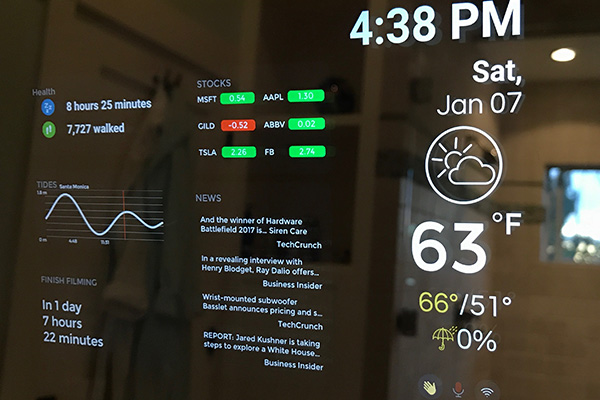
Now, for the first time, Martin has launched a Kickstarter fundraising campaign for his latest brainchild – the Firefly Smart Mirror. The Kickstarter campaign will only be funded if enough backers pledge sufficient funds and orders to reach the $35,000 goal by 8:40pm on Thursday, April 6, 2017.
Martin and Cohenzadeh ran across the concept of a voice-controlled smart mirror while looking for a way into the Internet of Things market. “We were particularly interested in Smart Home applications, and I began playing around with a smart mirror after seeing a do-it-yourself version on the Internet,” remembered Martin. “The DIY version involved putting mirror glass over a PC screen, but I realized that we had some old tablets lying around, so we began experimenting with an iPad mini.”
According to Martin, the goal was to create hardware without having to get into building new circuits. So he reached out to CSE student Alvin Ho (a former member on the hackathon team), who had become a 3D-printing aficionado with printers of his own. Ho brought in Alistair Twombly, a UC San Diego student majoring in mechanical and aerospace engineering.
Initially, the team wasn’t convinced to go with 3D printing. “Our initial versions were made mostly out of wood,” recalled Martin. “But they didn’t look good, too much like a DIY project, so Alistair went away for a few hours and came back with a 3D-printable computer-aided design (CAD) file.”
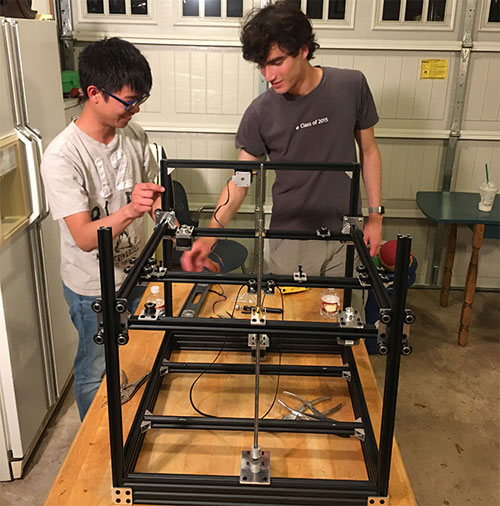
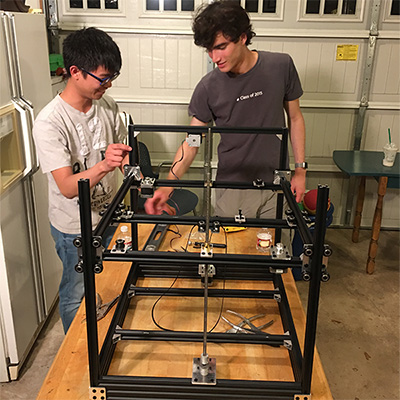
CSE student Alvin Ho building 3D printer
for constructing the Firefly Smart Mirror.
They used the CAD file on 3D printers of the Digital Media Lab in Geisel Library to develop the entire backing of the mirror, including the components that allow users to install different sizes of tablets behind the mirror, and position them wherever it is most convenient for viewing.
Initially, they built versions at one-tenth of normal size, but with encouraging results, they gradually scaled it up to a standard size that the Firefly team estimates it will deliver to initial Kickstarter investors this summer. The team also constructed 3D printers from scratch that are large enough to produce the primary size of the backing (initially for mirrors measuring 16 inches by 26 inches).
So far, the Kickstarter campaign’s 69 backers have committed over $7,000 to the “first tablet-powered smart mirror,” with 19 days to go toward the month-long campaign goal of $35,000.
According to Martin, in order to manufacture more Fireflys, the team will use some of the funding to invest in in-house 3D printers capable of printing the entire backing of the mirror glass. The product is designed to work with both iOS and Android tablets of any size, and the campaign promises that a special finish on the high-quality glass means that the display will always look crystal clear.
“Even in a bathroom with a hot shower running, we found that because of the heat generated by the tablet behind the mirror and the airflow through the backing, the part of the mirror in front of the tablet will not become foggy like it would normally with condensation,” explained Martin.
Since consumers are unlikely to want to leave marks on the mirror, the Firefly eschews touching of the glass. Instead, the mirror uses voice-recognition technology powered by Amazon Alexa and its Polly software for lifelike, customizable voice interaction. Instead of saying “Alexa” to wake the system, the user starts by saying “Firefly”. Alternatively, the software uses computer vision technology to recognize the face in front of the mirror and can wake itself up without being asked. Computer vision is also used for swipe detection. “We currently use it only to page through news articles by swiping your arm in front of the mirror,” said Martin. “We will include the swipes for news in the version this summer, and we’d like to add more gestures in future updates.”
For simple questions, Firefly responds locally, e.g., showing the weather data if asked “Firefly, what’s the weather?” For complicated questions that may not have been anticipated by the Firefly programmers, the mirror funnels additional requests to Amazon’s Alexa Voices Services API directly.
The companion app to run the Firefly display will be available for free as a standalone app, with premium features to be added via monthly subscription. For backers of the Kickstarter campaign, however, the Firefly app will get a free lifetime subscription for all coming premium features.
Backing the project on Kickstarter allows consumers to get one of the first Firefly Smart Mirrors for $150, but anyone who invests in the campaign at a smaller amount gets access to the Firefly software app. The app allows users to customize what the screen displays when the Firefly is active, or to trigger a connected device (e.g. an alarm or light) or other applets through IFTTT integration.
Related Links
Firefly Kickstarter Campaign
Firefly Smart Mirror
Review on 9to5Toys.com
ThnkDev